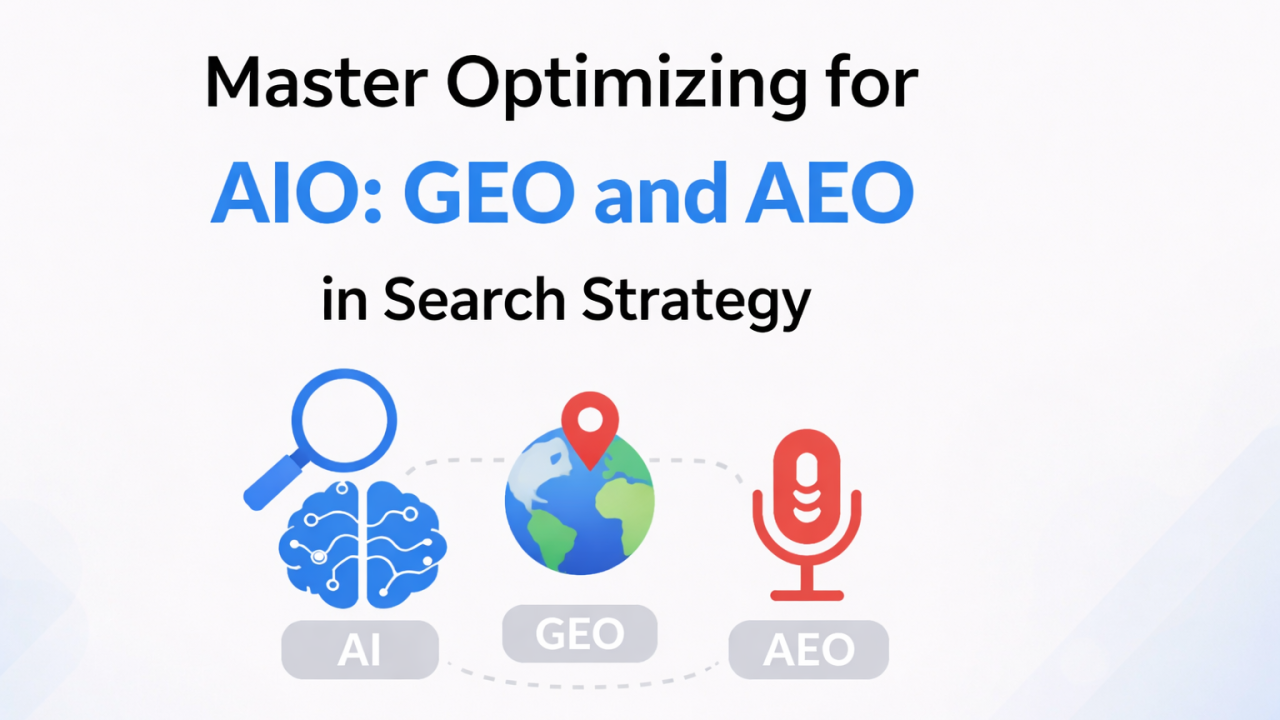
The Dawn of a New Era: Why AIO & GEO are Non-Negotiable for 2026 Visibility
The digital landscape is undergoing a seismic shift, fundamentally redefining how businesses achieve visibility and connect with their audience. For years, traditional Search Engine Optimization (SEO) was the undisputed king, focusing on keywords, backlinks, and technical prowess to climb search rankings. However, as 2026 rapidly approaches, the rise of Artificial Intelligence (AI) has ushered in a new paradigm, where users increasingly receive ready-made answers from generative AI platforms like ChatGPT, Gemini, Perplexity, Copilot, and Google's Search Generative Experience (SGE). In this AI-first world, simply appearing in search results is no longer enough; being *cited* as a trusted source by AI models is the new gold standard.
This profound disruption means that if your brand isn't included in the pool of sources AI uses to generate answers, you're effectively out of play. Traditional SEO, while still foundational, is no longer a guarantee of meaningful visibility. Enter
Artificial Intelligence Optimization (AIO) and Generative Engine Optimization (GEO) – not just fleeting trends, but essential strategies for maintaining brand recognition, trust, and sustainable growth in the era of AI-powered search. Especially for B2B enterprises eyeing international expansion, mastering AIO & GEO will be critical for achieving global market visibility and ensuring your content resonates with prospects' pains, bridging the gap to customers worldwide. The key performance indicator (KPI) is no longer solely organic visibility, but demonstrably, citability in AI-generated responses. The question every forward-thinking business owner must ask is: Is my business truly ready for the era of generative search and artificial intelligence optimisation?
What is Artificial Intelligence Optimization (AIO)?
Artificial Intelligence Optimization (AIO) is the strategic adaptation of your digital content to ensure it can be easily understood, processed, and utilized by Large Language Models (LLMs) and other AI systems. The core idea is deceptively simple: make your content so clear, coherent, and factually robust that AI can confidently extract information and answer user questions accurately based on your text, without misinterpreting or 'messing up'.
Unlike traditional search algorithms that might primarily count keyword density or analyze link profiles, AI reads, analyzes, and draws conclusions much like a human would. It seeks out context that is:
- Clearly Structured: Organized with headings, subheadings, lists, and short, digestible paragraphs.
- Specific and Factual: Rich in verified data, statistics, and concrete examples, minimizing ambiguity.
- Logically Sound: Presents complete thoughts, follows a clear argument, and avoids contradictions.
- From a Trusted Source: Originates from an authoritative and credible domain, reflecting high levels of Expertise, Experience, Authoritativeness, and Trustworthiness (E-E-A-T).
AIO goes beyond merely stuffing keywords; it's about crafting content that makes logical sense to both human readers and sophisticated AI algorithms. It's about becoming an undeniable source of truth that AI models can rely on. For more in-depth insights into adapting content for LLMs, refer to our article on
Artificial Intelligence Optimization (AIO): Adapting Content for LLMs.
Decoding Generative Engine Optimization (GEO): Beyond Traditional Search
Generative Engine Optimization (GEO) takes AIO a step further, specifically focusing on optimizing content for generative search engines. These aren't your typical search engines that merely provide a list of links; instead, they synthesize information to create a ready-made answer for the user. Think of platforms like Perplexity AI or the SGE experience in Google.
The primary goal of GEO is to optimize your content in such a way that these generative systems *trust* your material and select it as the foundational basis for forming their comprehensive answers. In this advanced environment, traditional SEO tactics like keyword repetition become less effective. What truly matters for GEO success are factors such as:
- Quality of Argumentation: Is your content well-reasoned, logically consistent, and supported by compelling examples? Does it present a complete and defensible viewpoint?
- Demonstrable Expertise: Can your competence and authority on the subject matter be clearly confirmed? This ties directly into your E-E-A-T signals.
- Clarity of Structure: Beyond basic formatting, does your content flow intuitively with well-defined sections, subheadings, and lists that make it easy for AI to parse and synthesize?
- Reliability of the Source: Is your publication considered a credible and authoritative entity in its niche? AI models prioritize information from sources known for accuracy and integrity.
A common question arises: Will GEO replace SEO? The answer is not replacement, but evolution and absorption. GEO doesn't discard the principles of SEO; rather, it represents an advanced stage where SEO evolves towards "search engine + AI discoverability." Fundamental SEO principles like relevance, technical optimization, and user experience remain crucial. However, they are now complemented by a deep understanding of how AI consumes and presents information. For a deeper dive into this evolution, check out
AIO & GEO: The Evolution of SEO for Generative AI Engines.
Practical Strategies for Mastering AIO & GEO in 2026
Adapting to the AIO and GEO landscape requires a proactive and strategic approach. Here are actionable tips to prepare your business for AI-powered visibility in 2026:
1. Embrace the "Answer-First" Content Mindset
Shift your content creation focus from merely covering a topic to directly answering potential user questions comprehensively and authoritatively. Anticipate the nuances of user queries and provide clear, concise, and definitive answers within your content. Structure your articles so that key questions are posed and answered explicitly, making it easier for AI to extract definitive information.
2. Build Unquestionable E-E-A-T
Experience, Expertise, Authoritativeness, and Trustworthiness (E-E-A-T) are more critical than ever.
- Experience: Showcase real-world application and hands-on knowledge.
- Expertise: Ensure your content is written or reviewed by subject matter experts. Clearly state author credentials.
- Authoritativeness: Position your brand as a leading voice in your industry through consistent, high-quality content and external recognition.
- Trustworthiness: Maintain accuracy, provide verifiable sources, and ensure site security and privacy. AI prioritizes sources it can implicitly trust.
3. Optimize for Clarity and Structure
AI thrives on clarity.
- Use Headings and Subheadings Logically: Employ H2s and H3s to segment your content, making it scannable for both humans and AI.
- Employ Lists and Tables: Break down complex information into digestible bullet points or numbered lists. Tables are excellent for presenting comparative data that AI can easily parse.
- Short, Punchy Paragraphs: Avoid dense blocks of text. Keep paragraphs concise and focused on a single idea.
- Utilize Q&A Formats: Directly address common questions in a clear question-and-answer format within your content.
4. Leverage Structured Data (Schema Markup)
Schema markup helps search engines and AI understand the context and relationships within your content. Implement relevant schema types (e.g., Article, FAQPage, HowTo, Product, Organization) to explicitly tell AI what your content is about, enhancing its chances of being cited for specific information.
5. Develop Multilingual Content Strategies for International GEO
For B2B companies targeting international growth, multilingual content is paramount. Beyond direct translation, adapt content culturally and linguistically to resonate with diverse global audiences. This demonstrates a deeper understanding of regional nuances, which AI models can identify as a sign of comprehensive knowledge and relevance. Each language version should be optimized for AIO and GEO independently, considering local search behaviors and AI model training data.
6. Focus on Contextual Relevance and Completeness
Instead of broad, shallow content, aim for deep, comprehensive coverage of specific topics. AI values content that explores a subject from multiple angles, providing complete and nuanced answers. Ensure your content addresses the 'what,' 'why,' 'how,' and 'who' of a topic.
7. Monitor AI Citations and Mentions
Just as you monitor backlinks, begin tracking when and where generative AI models cite your content. Tools and analytics will evolve to help businesses understand their "AI visibility score." This feedback loop will be crucial for refining your AIO and GEO strategies.
Conclusion
The year 2026 marks a pivotal moment in digital marketing, where AIO and GEO are no longer optional but fundamental for securing AI-powered visibility. The shift from traditional search to generative AI discovery demands a rethinking of content creation, emphasizing clarity, trust, and comprehensive answers. By prioritizing content that is meticulously structured, factually robust, expertly authored, and culturally adapted, businesses can not only survive but thrive in this new landscape. Adapting now is not merely about staying competitive; it's about cementing your brand's authority and ensuring its continued relevance as AI becomes the primary channel for information consumption and lead discovery. Embrace the evolution, master AIO & GEO, and guide your business to unprecedented visibility in the AI era.